
Shopping Cart
Treeless saddle for horses with prominent withers or a curved back
A treeless saddle like Ghost can be an interesting solution for horses with prominent withers or unusual back conformation, because its flexible structure follows the back very well. However, the result depends on proper saddle fitting, the saddle pad, the spinal channel, and the overall balance of the system.
When the horse’s conformation makes saddle fitting difficult
Not all horses have a back that is easy to fit with a saddle.
A very prominent withers, an especially curved back or, conversely, a conformation with little muscle coverage can make it more difficult to find a saddle that maintains all of the following at the same time:
- sufficient clearance at the withers;
- no pressure on the spine;
- good weight distribution;
- stability during movement;
- freedom of movement for the shoulders;
- proper balance for the rider.
In the case of prominent withers, for example, it is not enough to check the saddle’s position while standing still. The clearance from the withers must remain adequate when the rider mounts and during movement.
Similarly, a back that changes shape during work may require a dynamic assessment rather than merely a static one.
Saddle fitting, therefore, is not simply about finding a saddle of the right size: it means assessing how the horse, saddle, saddle pad and rider interact with one another.
Why a saddle without a tree can be interesting
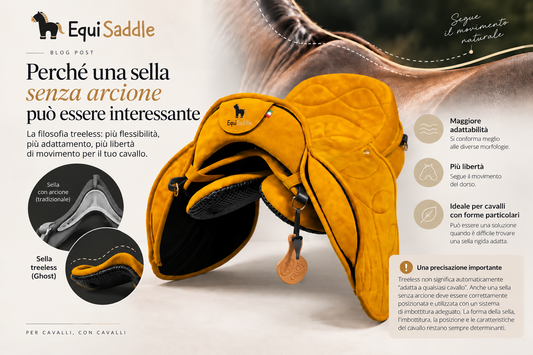
The fundamental characteristic of a treeless saddle is the absence of the traditional rigid tree.
In a traditional saddle, the tree forms a rigid structure that helps determine the saddle’s shape and how it interacts with the horse’s back.
A Ghost treeless saddle, on the other hand, follows a different philosophy: its structure is more flexible, allowing the saddle to adapt more closely to the shape of the horse’s back.
This can be particularly useful when the horse has a back shape that makes it difficult to find a satisfactory fit with a rigid structure.
But there is an important qualification: treeless does not automatically mean “suitable for every horse”.
A treeless saddle must still be positioned correctly and used with an appropriate padding system. Research on pressure distribution shows that treeless construction does not, in itself, eliminate the problem of pressure: the saddle’s shape, padding, position, and the horse’s characteristics remain decisive factors.
Ghost: the advantage of a treeless system
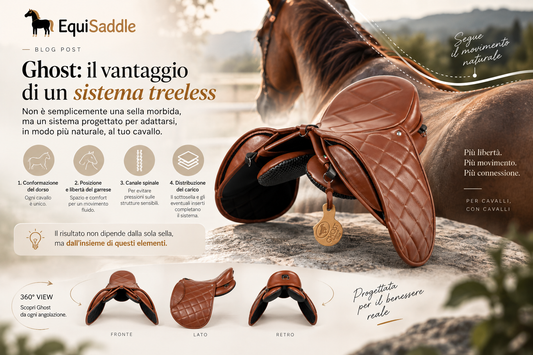
In the case of Ghost, the concept of a treeless saddle should not simply be considered as “a soft saddle.”
The point is the overall system.
The saddle’s flexibility allows for contact that adapts more closely to the horse’s conformation, while the saddle pad and any inserts help create the correct support configuration.
For this reason, when evaluating a Ghost, at least four elements should be considered:
- back conformation;
- withers position and clearance;
- spinal channel;
- load distribution through the saddle pad.
The result therefore does not depend on the saddle alone.
Prominent withers: what to check
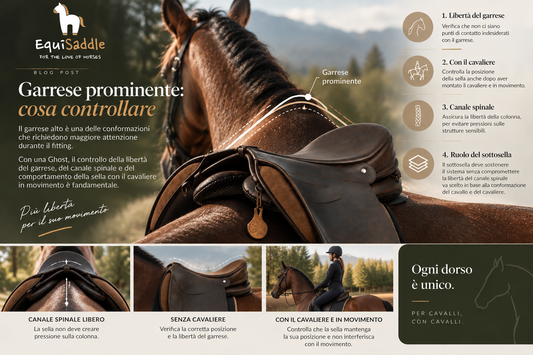
A high wither is one of the conformations that requires the greatest attention during fitting.
The first check concerns clearance around the withers and the spinal line. The saddle must not create unwanted contact with these structures.
It is also important to check what happens after the rider has mounted.
A saddle that seems correct when the horse is standing still can change position when it is loaded and when the horse starts moving. For this reason, the fit should also be checked under dynamic conditions.
The Ghost saddle pad therefore plays a particularly important role: it must support the system without compromising the freedom of the spinal channel and must be chosen according to the conformation of both the horse and the rider.
Flexed back, dorsal, or with a particular shape
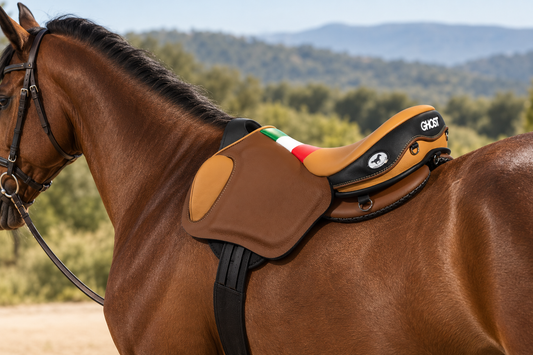
A very curved back, a poorly muscled topline, or an asymmetrical conformation can make it difficult to achieve even contact with a rigid structure.
A treeless saddle may offer greater adaptability precisely because it does not impose a predefined rigid shape on the horse’s back.
However, this does not mean that it is enough to place the saddle on the horse and ride.
The right question is not:
"Does the Ghost fit the horse’s back?"
but:
"Does the Ghost, with the correct saddle pad and the correct setup, create a stable, balanced, and comfortable system for this specific horse and this specific rider?"
That is the real question in saddle fitting.
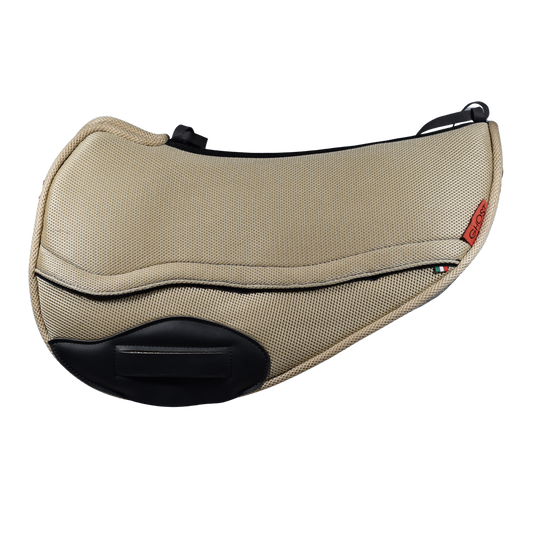
The role of the saddle pad and inserts
With treeless saddles, the saddle pad is not simply an accessory intended to protect the saddle from sweat.
It is part of the fitting system.
Its function may include helping to:
- keep the spinal channel clear;
- support weight distribution;
- compensate for certain conformational characteristics;
- improve saddle stability;
- create a suitable interface between horse and saddle.
The choice of pad must therefore take into account the horse, the rider’s weight and position, as well as the saddle’s specific configuration.
Even in the world of treeless saddles, the principle remains the same: a flexible saddle does not eliminate the need for proper fitting.
Treless does not mean “a saddle for everyone”
One of the main misconceptions about treeless saddles is thinking that the absence of a tree automatically makes the saddle universal.
That is not the case.
Every horse has a different conformation, and even a treeless saddle may be unsuitable if:
- the saddle pad is not appropriate;
- the spinal channel does not remain sufficiently clear;
- the load distribution is inadequate;
- the saddle is not balanced;
- the rider’s weight or position is not compatible with the system;
- the saddle does not remain stable during movement.
The fact that a saddle is flexible is therefore a tool for adaptability, not a guarantee of a perfect fit.
How to check the fit of a Ghost
Before assessing the saddle in motion, it is useful to check a few basic aspects.
1. Position
The Ghost must be positioned correctly on the horse’s back, following its conformation and leaving the shoulder area clear.
2. Garrese
The withers must remain clear and must not come into contact with the saddle or with a saddle-pad configuration that creates pressure.
3. Spinal canal
The central line of the back must remain clear.
It is important to consider not only the shape of the saddle, but also the shape actually created by the saddle + pad + inserts system.
4. Balance
The saddle must maintain a consistent balance with the horse’s back and the rider’s position.
A saddle that constantly tends to slip forward, backward, or sideways warrants an assessment of the fit, the position, and the entire system.
5. Movement
The most important check comes when the horse is walking and working.
Fit should be assessed by observing saddle stability, shoulder freedom, and the rider’s position during movement.
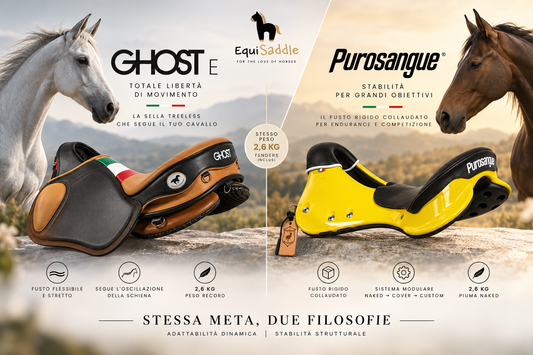
Ghost or saddle with a pommel? There is no universal answer
Talking about saddle fitting also means recognizing that there is no single construction suitable for every horse, rider, and discipline.
The choice between a treeless saddle and a saddle with a rigid structure should be based on the horse's conformation, the intended use, the type of work, and the needs of the horse-and-rider combination.
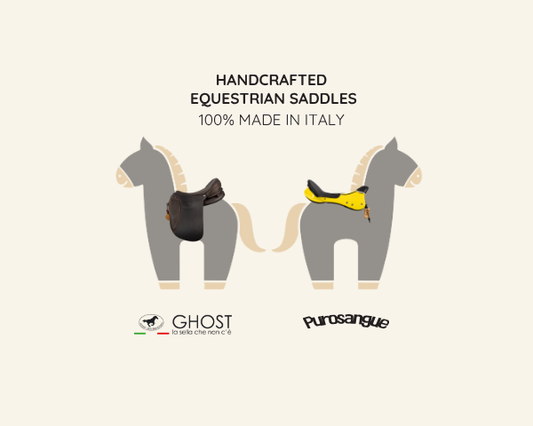
That is why EquiSaddle offers two different construction philosophies.
On one hand, there is Ghost, the system of treeless, flexible saddles designed for those seeking the benefits and adaptability of a treeless construction.
On the other hand, there is Purosangue, with a rigid tree, developed specifically for Endurance and Trekking.
It is therefore not a matter of deciding which of the two is "better" overall, but of understanding which system is most suitable for the horse and the intended use.
Within the Purosangue range, the Naked Piuma saddle is one of the benchmark models for those seeking a rigid-tree construction for Endurance and Trekking.
There are also configurations designed for specific needs within the Ghost range: for example, Ghost E is the line designed for Endurance and Trekking. However, the basic principle remains that of Ghost: a treeless, flexible saddle that should be assessed through proper fitting.
When does it make sense to consider a Ghost?
A Ghost can be particularly interesting when considering a treeless solution for:
- horses with unusual back conformations;
- horses with prominent withers;
- horses whose conformation changes over time;
- horses for which it is difficult to find a good fit with a rigid tree;
- riders seeking more direct contact and greater saddle adaptability.
However, the assessment must always be individual.
If the horse shows pain, significant asymmetries, muscle loss, or movement problems, choosing a saddle should not replace a veterinary or professional assessment.
How to choose the right Ghost
The choice should not simply start from the model you like best.
It is more useful to start with a few questions:
- What is the horse's back like?
- How prominent is the withers?
- What discipline is practiced?
- How much does the rider weigh?
- How does the horse move under saddle?
- Which saddle pad and configuration provide the best balance?
Only after answering these questions is it possible to assess which Ghost configuration is most suitable.
For this reason, a personalized saddle fitting service can be particularly useful when the horse's conformation is complex or when you are unsure which configuration to choose.
Would you like to find out whether Ghost could be suitable for your horse?
The simplest way to get started is not to choose a saddle based solely on a catalog photograph.
It is to start with the horse.
With a fitting assessment service, it is possible to analyze the horse's back conformation, withers, saddle position, and the needs of the horse-and-rider combination in order to identify the most appropriate configuration.
And when it is possible to try the saddle in practice, the Demo Saddle allows you to evaluate the system on your own horse before making a purchasing decision.
Would you like to find out which Ghost could be most suitable for your horse? Start with a fitting assessment or request a Demo saddle.
Frequently Asked Questions (FAQ)
Is a treeless saddle suitable for horses with high withers?
It can be, but not automatically. Wither clearance must be evaluated together with the position of the saddle, the saddle pad, and the horse’s movement.
Is the Ghost suitable for every horse?
No. Even a treeless saddle requires proper fitting. The horse’s conformation, the rider’s weight and position, the saddle pad, and the discipline practiced must be assessed together.
Does a treeless saddle always protect the horse’s back from pressure?
No. The absence of a saddle tree alone does not guarantee optimal pressure distribution. The result depends on the construction of the saddle, the padding system, the fitting, and how it is used.
Is Ghost suitable for Endurance and Trekking?
The Ghost range also includes Ghost E, designed for Endurance and Trekking. For these disciplines, EquiSaddle also offers Purosangue, a different philosophy with a rigid tree. The choice depends on the horse’s characteristics and the rider’s needs.
Better Ghost or Purosangue?
There is no one-size-fits-all answer. Ghost and Purosangue have different constructions: Ghost is a flexible treeless solution, while Purosangue uses a rigid tree and is designed for Endurance and Trekking. The choice should be based on the horse-and-rider combination and intended use.
Can I try a Ghost before buying one?
Yes. The most useful solution, especially when there are doubts about fit, is to consider using a Demo saddle and check how the system performs on your own horse.