
Shopping Cart
Best sellers

starting from
Regular price
€1.464,00
Price on demand
starting from
Regular price
€2.170,00
Price on demand
starting from
Regular price
€1.208,00
Price on demand


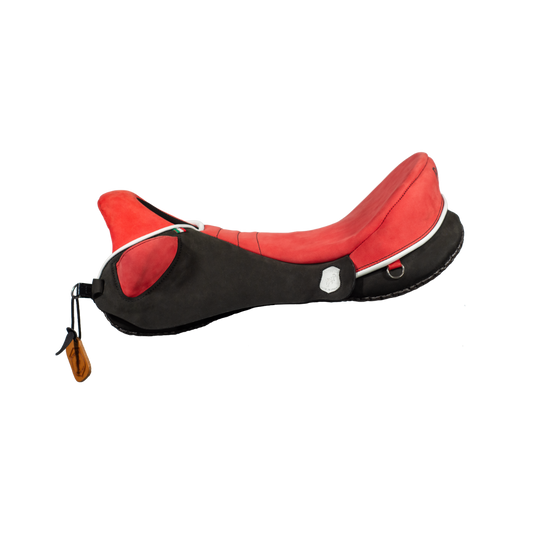
Ghost Velocity Saddle - E Line
starting from
Regular price
€1.464,00
Price on demand
starting from
Regular price
€1.208,00
Price on demand

starting from
Regular price
€1.360,00
Price on demand
Ghost E: the ultra-lightweight treeless line for Endurance
The Ghost E is the Ghost line developed specifically for Endurance and long distances, with a flexible, lightweight and modular treeless structure.
Compared with traditional Ghost saddles, the E line uses a specific base with a narrower, more minimalist profile, designed to give the rider a close-contact sensation and reduce bulk beneath the leg.
In the configurations currently offered by EquiSaddle, the weight can be as little as 2.6 kg with fenders included, making the Ghost E particularly interesting for those seeking lightweight design during Endurance, trekking and many hours of outdoor work.
The line is currently offered by EquiSaddle in the three models Velocity, Voyager and Zephyr, which share the Ghost E structure but differ mainly in their flaps and supports, offering riders different sensations.
A modular and configurable structure
One of the distinctive features of the Ghost E is the possibility of configuring several saddle components separately.
Ghost offers configurations with E-Arch or with blocks, as well as line-specific components such as padded fenders, stirrup leathers with mini-fenders and a COCI seat.
The Ghost E also has two stirrup-leather attachment positions, and the seats can be interchanged between compatible E configurations. Front and rear rings make it possible to add the equipment needed for long distances.
This modularity makes it possible to distinguish between two important aspects of the choice: on the one hand, the model and configuration best suited to the rider, and on the other, fitting the horse.
A flexible and adjustable structure does not, in fact, mean that the same configuration is automatically suitable for every horse.
Which Ghost E to choose: Velocity, Voyager or Zephyr?
The choice between Velocity, Voyager and Zephyr mainly concerns the relationship between rider and saddle: amount of support, leg freedom and lateral coverage.
Instead, we do not use these three models as an automatic classification for short, medium, or long backs: saddle fit on the horse depends on the saddle's overall configuration.
Ghost E Velocity: minimalist and close contact
The Velocity represents the most minimal configuration in the Ghost E line.
The reduced flaps limit bulk under the leg and prioritize close contact and freedom of movement, while retaining the ultralight construction characteristic of the E line.
It is particularly appealing to endurance riders looking for a minimalist configuration and a very direct feel with the horse, without especially restrictive front support.
Choose Velocity if: you prioritize simplicity, close contact, and great freedom of movement for the leg.
Ghost E Voyager: greater leg support
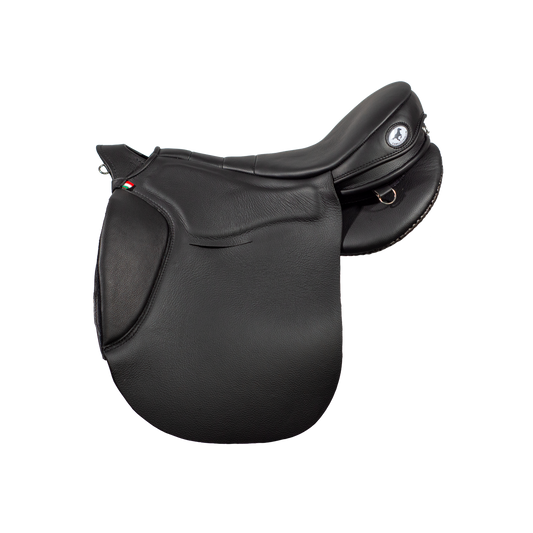
The Voyager stands out for its more pronounced front supports, which provide the rider with a greater reference for the leg than the more open configuration of the Velocity.
This configuration can be particularly appealing during long hours in the saddle, on varied terrain and technical trails, or simply for riders who prefer to feel more supported.
Choose Voyager if: you want to retain lightweight design and close contact, but prefer a more prominent reference for the leg.
Ghost E Zephyr: long flap and greater coverage
The Zephyr retains the Ghost E structure and stands out mainly for its long, shaped flaps.
Compared with more minimal configurations, it offers greater lateral coverage and is designed for riders who prefer a more extended flap during Endurance, trekking, and prolonged outdoor use.
Choose Zephyr if: you want to combine the lightweight design of the Ghost E with a long flap and greater lateral coverage of the leg.
Velocity, Voyager, and Zephyr at a glance
Velocity → minimal flap, close contact, and great freedom of movement for the leg.
Voyager → more prominent front supports and greater leg reference.
Zephyr → long flap and greater lateral coverage.
The choice among the three models therefore depends primarily on how the rider wants to feel and move in the saddle, not simply on the length or shape of the horse's back.
Technical features of the Ghost E line
The Ghost E combines several elements developed to create a particularly lightweight, modular saddle geared toward long distances.
The features of the line include:
- a flexible treeless structure;
- a specific Ghost E base with a narrow, minimalist profile;
- separate, configurable panels;
- two stirrup-leather attachment positions;
- the option to use stirrup leathers or fenders specific to the E line;
- interchangeable seats between compatible E configurations;
- front and rear rings for equipment;
- the option to configure it with a COCI seat;
- the option to choose configurations with different leg supports;
- customization of materials, colors, and finishes.
The actual configuration may vary depending on the model and selected options.
When to choose a Ghost E
The Ghost E is particularly appealing to those who practice Endurance, trekking, trail riding, and activities involving many hours in the saddle and are looking for a very lightweight treeless solution that stays close to the horse.
It may be worth considering if you are looking for:
- very low weight and bulk;
- a close contact feel;
- a flexible treeless structure;
- the option to configure the panels according to the fitting requirements;
- different levels of leg support and coverage;
- the option to choose between stirrup leathers and fenders;
- a saddle strongly geared toward long distances and outdoor use.
The Ghost E can of course also be used for everyday work and trail riding, but its design is particularly geared toward Endurance and prolonged outdoor use.
When the Ghost E might not be the ideal choice
The Ghost E may not be the most suitable solution if you are looking for:
- the feel and behavior of a rigid-tree saddle;
- a highly specialized geometry for a discipline practiced mainly in the arena;
- a highly structured, supportive seat;
- a solution that does not require assessing panel configuration, position, and balance for each individual horse.
A treeless saddle must also be configured and positioned correctly.
The absence of a rigid tree does not automatically make a saddle suitable for every back: load distribution, spinal clearance, balance, and stability must be assessed for each individual horse.
Ghost E and horse conformation
The flexible structure, the compact profile of the E base, and the ability to adjust the panel configuration make the Ghost E an interesting solution to consider for horses with very different characteristics.
This does not mean, however, that Velocity, Voyager, or Zephyr are automatically “the saddle for the Arabian horse,” “for the short-backed horse,” or “for the round horse.”
The model mainly determines flap, support, and interface with the rider.
For the horse, panels, rigging, any shims, position, and the saddle's overall balance must instead be assessed.
A Ghost E can therefore also be considered for compact horses, with little usable space for the saddle or a very mobile back, but the suitability of the configuration must be verified for the individual horse-rider combination, rather than simply inferred from the model selected.
Ghost E or rigid-tree saddle?
Ghost E and a rigid-tree saddle address the demands of long-distance riding through two different construction philosophies.
The Ghost E uses a flexible, very lightweight, modular treeless structure, allowing adjustments to the configuration of several components.
A saddle with a rigid tree, such as the Purosangue line, is instead based on a stable structure with defined geometry, around which the other saddle elements are configured.
There is no universally better solution for all horses: the choice must take into account the horse's conformation and movement, the rider's characteristics, fit, and intended use.
Therefore, when the choice is between Ghost E and Purosangue, it is more useful to compare the two different constructions on the individual horse-rider combination than to choose simply based on the discipline.
Information and technical review
Technical content by EquiSaddle.
The information in this guide supplements the Ghost technical specifications with EquiSaddle's experience in configuring saddles and selecting different solutions for horse and rider.
The information is intended to help understand the differences between the models and does not replace an assessment of the fit on the individual horse.