Selection guide: treeless saddle or rigid tree for endurance riding

If you are outfitting your horse for endurance or trekking, you have probably already discovered that choosing a saddle in this field is far from as straightforward as in other disciplines. Unlike show jumping or dressage, where technical tradition has converged on well-established solutions, long-distance riding brings together two radically different design philosophies — each with solid arguments in its favor.

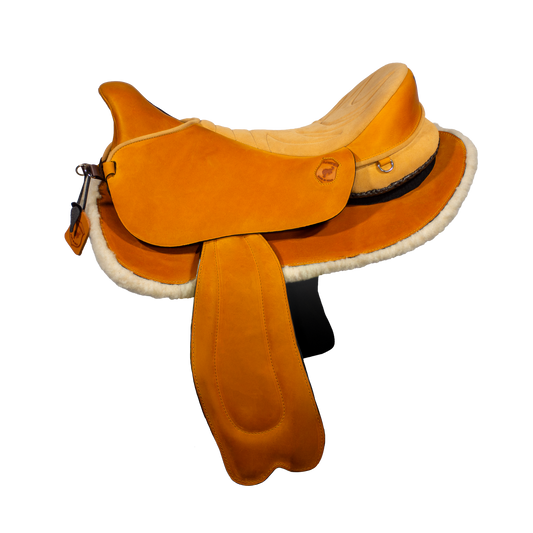
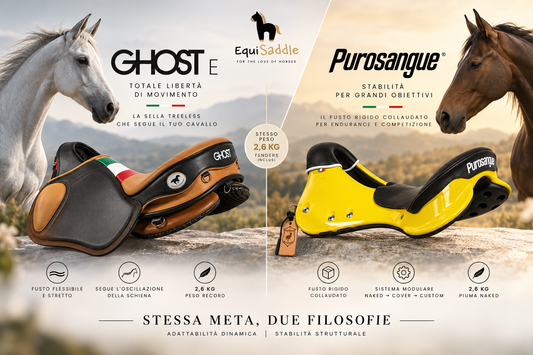
In this guide, we directly compare the two EquiSaddle lines designed specifically for endurance and trekking: Ghost E, the treeless line with a flexible structure and narrow tree (Arabian), and Purosangue, the modular rigid-tree collection built around a single proven frame. This is not a comparison between a “right” product and a “wrong” one: they are two different technical approaches, and both can achieve record weights in the lightest range of the lineup — the real difference lies in the construction philosophy, not (only) in the weight.

This is also one of the rare cases in which choosing between two seemingly opposing philosophies does not depend on the factor one would expect to find at the top of the list. Before getting there, however, it is useful to understand how the two structures work in detail, because that is where the real practical differences in the saddle originate.

The main differences at a glance: treeless or rigid equestrian saddle

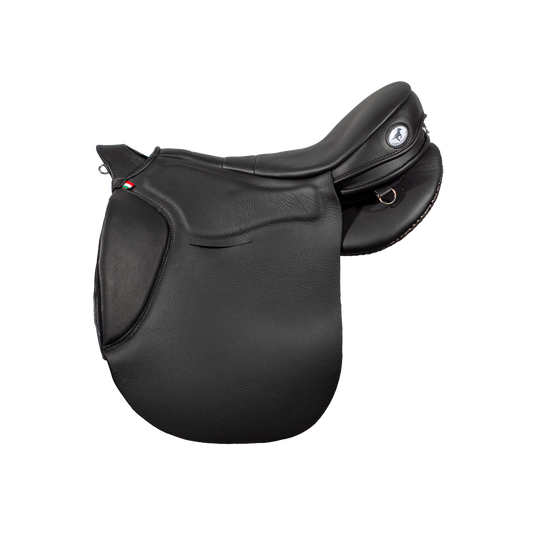
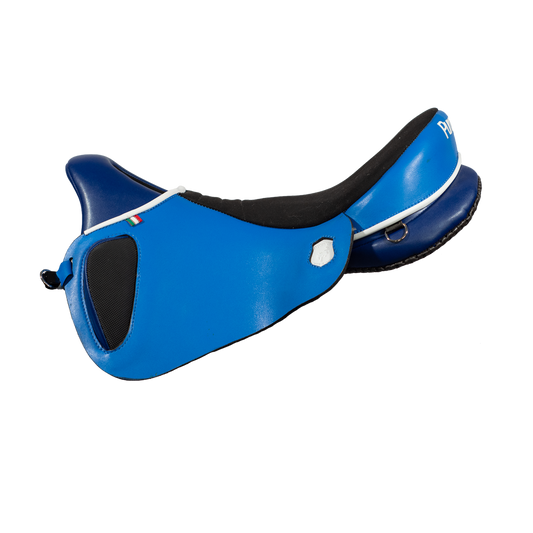
Ghost E and Purosangue address the same issue — horse comfort over hours of continuous work — with two opposing structures. Ghost E is completely treeless, with a flexible, narrow tree (record weight of 2.6 kg, fenders included) that follows the movement of the back in real time. Purosangue retains a proven rigid tree around which an entire modular system revolves (the Purosangue Naked, Cover and Custom lines): the flagship model, the Piuma Naked, also weighs 2.6 kg, demonstrating that the real choice is not between “light” and “heavy,” but between the back’s dynamic adaptability and the structural stability of a fixed support point.

Let’s take a detailed look at how the two philosophies work and when one is preferable to the other.

The two endurance saddle philosophies compared

Ghost E: dynamic adaptability and narrow tree for endurance

The Ghost E line was created as an evolution of previous endurance designs (such as the Quevis or Quilty models), with a visibly narrower tree than standard Ghost saddles. 

This design choice frees the back muscles, encourages the back to swing, and reduces interference in the paravertebral area, with a more collected seat closer to the horse — a feel that, according to the product’s own technical specifications, in some ways resembles Purosangue saddles.

The distinguishing feature of the Ghost E is the complete absence of billets or stirrup leathers crossing the spine: the self-adjusting external “Y” rigging system is integrated into the saddle base, ensuring stability without creating localized pressure points on the back. The panels feature a central “relieved” area beneath the seat and are adjustable with Velcro to follow the horse’s muscular changes over time.

Dual stirrup-leather positions and thigh supports

Two technical details distinguish the Ghost E from many other general-purpose treeless saddles: the dual attachment positions for the stirrup leathers, which allow the setup and leg position to be customized according to the riding style, and the thigh supports, or knee rolls, designed to provide support and stability without ever restricting movement — a compromise between the freedom typical of treeless saddles and a minimal postural reference for the rider, especially useful during the final hours of a long ride, when fatigue begins to set in.

Discover Ghost E

Purosangue: a unique tree, an entire modular system

Purosangue – modular rigid tree system

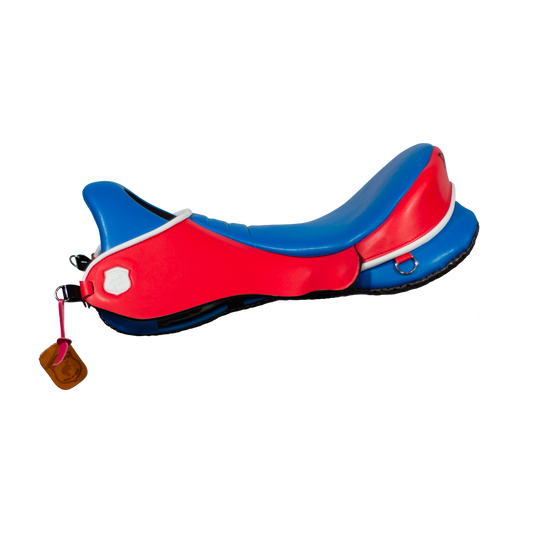
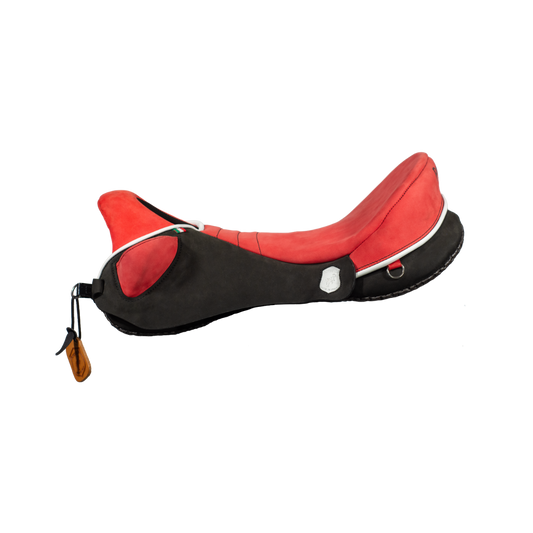
Purosangue is not a single model but a project structured around three lines (Naked, Cover, Custom) built around a single rigid tree, solid and proven: what changes between the lines is the level of covering and contact, not the basic structural balance. This modular approach allows the horse-and-rider partnership to “evolve” the saddle over time, moving from an essential configuration to a more covered one without changing the technical base.

The reference model in the Naked line, the Piuma, represents the extreme of the Purosangue philosophy: a 37 cm (14.5") rigid tree exposed, completely free of flaps, with stirrup leathers and billets attached directly to the tree with concealed screws to eliminate any thickness beneath the rider’s thigh. The result is a record weight of 2.6 kg, fenders included — exactly the same weight range as the Ghost E, but achieved by eliminating the bulk around a rigid tree, not by eliminating the tree itself.

The rigid tree, in this sense, is not a compromise compared with treeless: it is a construction choice with a specific advantage. A fixed, proven support point distributes the rider’s weight over a stable area that remains predictable in every gait, without depending on the long-term durability of a panel or a Velcro adjustment. It is the same principle why, in high-level competitive endurance, the rigid tree remains the most widespread structure among horse-and-rider partnerships tackling long distances in competition.

Discover Purosangue

The Coci seat: a feature across the entire Purosangue and Ghost range

A technical detail shared by the Purosangue and Ghost lines, available as an option across the entire range, is the saddle with a central opening: a cutout in the seat designed to redistribute weight and reduce pressure on the rider’s lower back. On routes measured in hours rather than kilometers, this ergonomic feature affects the rider’s comfort just as much as the saddle’s construction affects the horse’s comfort—an aspect often overlooked in technical comparisons, which almost always focus solely on equine well-being.

Comparison table: Ghost E vs Purosangue Piuma for endurance

Treeless or Rigid-Tree Endurance Saddle – EquiSaddle

The most interesting takeaway from this comparison is that, with these two flagship models, weight is no longer a deciding factor: both achieve the same record-low weight. The real choice comes down to the other key characteristics.

FeatureGhost E (treeless)Purosangue Piuma Naked (rigid tree)
ConstructionFully flexible, treeless constructionExposed rigid tree, 37 cm / 14.5"
Weight (fenders included)2.6 kg2.6 kg
Dynamic adaptabilityFollows the movement of the horse's back in real timeThe tree accommodates the flexion of the horse's back without deforming
Stability of the weight-bearing areaDepends on panel adjustment over timeFixed and predictable in all conditions, without relying on adjustments
Horse-rider contactCompact seat with a narrow twistDirect contact, with a "bareback with stirrups" feel
FlapsPresent (vary by model: Scout, Zephyr, Voyager, Velocity...)None on the Piuma, for maximum close contact
Stirrup leather / rigging attachmentExternal Y-shaped rigging; no components cross the spineAttached directly to the tree, with no added bulk beneath the thigh
Back ventilationPressure-free central channel with sweat-wicking panelsOpen shell above the spine
Long-term modularityInterchangeable panels and interchangeable seats within the same sizeModular system across three ranges (Naked/Cover/Custom), using the same tree
Recommended conformationsArabian horses, short backs and highly mobile backsArabian or Thoroughbred horses, including those with prominent withers; not recommended for rounder conformations

Why weight is no longer the decisive factor in endurance riding

In the general comparison between “saddle with a tree” and “treeless saddle,” weight is almost always the main argument in favor of treeless saddles. But when looking specifically at the top-of-the-range models designed for competitive endurance—Ghost E on one side, Purosangue Piuma on the other—this advantage disappears: both weigh 2.6 kg, fenders included. This means that for anyone considering a purchase primarily to reduce the load on the horse’s back, the choice should shift to other criteria: the structure’s dynamic behavior, the rider’s sense of contact, and the horse’s specific conformation.

Biomechanical challenges over long distances: managing heat and prolonged pressure

Regardless of the saddle chosen, long-distance riding presents a common challenge: managing heat and pressure over a much longer period than in other disciplines.

How the two structures handle hours of continuous work

The two philosophies solve the same problem — maintaining stable, well-distributed pressure for hours — with two opposing approaches, both of them valid.

On the Ghost E, the absence of rigid elements eliminates fixed pressure points by design: however, the result depends largely on the quality and adjustment of the panels, which must correctly follow the horse’s muscular changes during exertion — a system that requires attention and active maintenance throughout the ride.

On the Purosangue Piuma, the rigid tree tackles the issue from the opposite direction: rather than adapting point by point, it distributes weight over a broad, consistent support area whose behavior does not change with heat, sweating, or muscular fatigue in the horse during the final hours — a level of predictability that, on very long rides, reduces the risk of changes in balance precisely when horse and rider are most tired and least able to perceive them. The shell is also designed open along the spine to ensure ventilation and spinal clearance, while the removable panels in different thicknesses (1, 1.5, or 2 cm) make it possible to fine-tune the protection according to the shape of the horse’s back.

Heat dissipation along the back with treeless and rigid saddles

In both systems, continuous ventilation above the spine is an explicit design feature, showing that the issue of overheating along the back during long-distance rides is central to both construction philosophies, not exclusive to treeless saddles.

Why the rigid tree is technically superior in high-level competitive contexts

The Piuma Naked is not designed as a “light but rigid” compromise: the product specification explicitly describes it as intended for professional competitive endurance, with a design that addresses the typical seated canter of endurance races as a specific use case, not a generic one. Several technical features explain why the rigid tree holds its own even at the most demanding levels:

  • “Hybrid-saddle” system: the load-bearing structure of the Piuma is not merely a rigid shell, but acts as an active cushioning buffer that integrates with the horse’s morphology — a hybrid combining the stability of the tree with a cushioned response, designed specifically for extended galloping.
  • Zero interference with the rider’s position: the stirrup leathers and billets are screwed directly to the tree using recessed screws, eliminating any bulk beneath the thigh and the classic “dancing” effect of the legs — a factor that matters especially in the final hours of a race, when positional precision tends to decline due to fatigue.
  • Shell material: made from high-strength molded polyurethane, designed to balance structural rigidity and ergonomic flexibility, with billets made from technical synthetic material designed not to give way over time — a direct response to the wear caused by the continuous hours of work typical of endurance races.
  • Horse cardiac recovery: on the product page, the record weight of 2.6 kg is presented not merely as “lightweight design,” but as a functional choice aimed at maximizing the horse’s cardiac recovery — a parameter that is as central to competitive endurance as speed, because it directly affects veterinary clearance to continue the race.

Even those who tried the Piuma while initially skeptical of lightweight saddles describe the integrated structure as capable of eliminating the feeling of “suspension” that makes the legs bounce, with an effect close to bareback riding but with the security of stirrups.

These features do not make the rigid tree “superior” in absolute terms: they remain valid for the conformations and riding styles for which the Purosangue is recommended (see the comparison table). But they should be understood as fully-fledged technical arguments, explicitly designed for competitive use — not as compromises accepted in exchange for lightweight design, which, as noted, the Piuma Naked now achieves anyway, matching the Ghost E.

Maintenance and long-term durability

The two structures also differ when it comes to maintenance, with equally sound approaches.

On the Ghost E, the modularity of the interchangeable velcro-attached panels allows you to make adjustments yourself as the horse changes shape, without necessarily involving an external technician — an advantage in terms of speed of intervention.

On the Purosangue, the proven rigid tree is designed to remain stable and unchanged over time: it is the technical foundation, not an element subject to adjustment, which means one less parameter to monitor or tune before each outing — a point in its favor for those seeking maximum consistency in their riding position from one competition to the next. The elements that wear out — panels, coverings — can still be replaced individually thanks to the screw-fastening system, without having to work on the entire saddle.

In both cases, the construction philosophy favors targeted replacement of components over the complete reflocking typical of traditional general-purpose saddles — the difference is whether this targeted replacement concerns a system that can be adjusted over time (Ghost E) or accessory components around a base that remains fixed (Purosangue).

Purosangue Naked

essential, direct, lightweight design — the immediate choice for those seeking the ultimate in lightweight design and pure competition endurance.

Purosangue Naked Piuma Saddle

starting from
Regular price €1.464,00
Price on demand
+ VAT: €322,08 (ONLY FOR ITALY)
I started out biased, fearing the instability of lightweight saddles, but the Piuma is a surprise. The integrated structure eliminates that 'suspension' feeling that makes your legs swing: it's like riding bareback, but with the security of stirrups. The horse showed a freedom of movement in the shoulders never experienced with other saddles on the market.
How to choose between Ghost E and Purosangue: questions to ask yourself

Rather than looking for a universal answer, it is best to answer these questions about your specific case:

Does your horse have a short, flexible back, or is it an Arabian horse that does not tolerate rigid saddles well? Ghost E is explicitly designed for this type of conformation, thanks to its narrow tree and adjustable panels.

Is your horse an Arabian or Thoroughbred, even with a pronounced withers, but with a non-rounded conformation? The rigid Purosangue tree is specifically suited to this profile, with the explicit warning to avoid it on rounded conformations.

Are you aiming for high-level competition and a position that remains consistent from one race to the next? The rigid Purosangue tree offers the structural predictability and direct power transfer that many competitive horse-and-rider pairs seek over long distances.

Do you prefer a direct-contact feel like "bareback riding with the security of stirrups", or a more enclosed seat that can be adjusted over time? These are two different sensations in the saddle, and they are worth trying before deciding: Piuma Naked focuses entirely on essential contact, while Ghost E offers a narrow but still structured seat.

Would you like to be able to evolve the saddle over time by switching to a more complete covering without changing the technical base? The modular Purosangue system (Naked → Cover → Custom) is designed specifically for this progression.

Not sure which of the two lines is better suited to your horse and your type of riding? You can configure your personalized Endurance/Trekking kit with the support of our technical team, or explore the Ghost E and Purosangue collections directly.

Discover the endurance lines

Essential accessories for competition or trekking

Essential accessories for competition or trekking

Regardless of the model chosen, some accessories directly affect the success of a long ride.

Anatomical girth and technical saddle pad

Both lines feature dedicated technical saddle pads, designed to work in tandem with the specific structure of the chosen saddle—a detail not to overlook, because even with the Purosangue Piuma, the compatible technical saddle pad is among the recommended accessories listed on the product page.

Rings and load-carrying system

Both Ghost E and Purosangue Piuma include D-rings as standard for attaching water bottles and saddlebags, with the option to add extra rings on request for carrying veterinary or rescue equipment along the route.

Protections for girths and billets

For both lines, buckle protectors and keepers protectors for girths and billets are available as optional accessories, configurable in various finishes (full-grain leather, micronappa, oiled nubuck). They are not purely aesthetic elements: on long rides, protecting the metal attachments reduces friction and the risk of minor contact irritation during hours of continuous work.

Domande Frequenti (FAQ)

Ghost E and Purosangue: which is lighter?

Is the Purosangue Piuma suitable for all endurance horses?

Is the Ghost E suitable for horses with a short back?

Is the stiff tree really more suitable for high-level competition?

Si può passare dalla linea Naked Purosangue a un modello più rivestito in un secondo momento?

Does Ghost E require a different saddle pad than Purosangue?